Nivaran
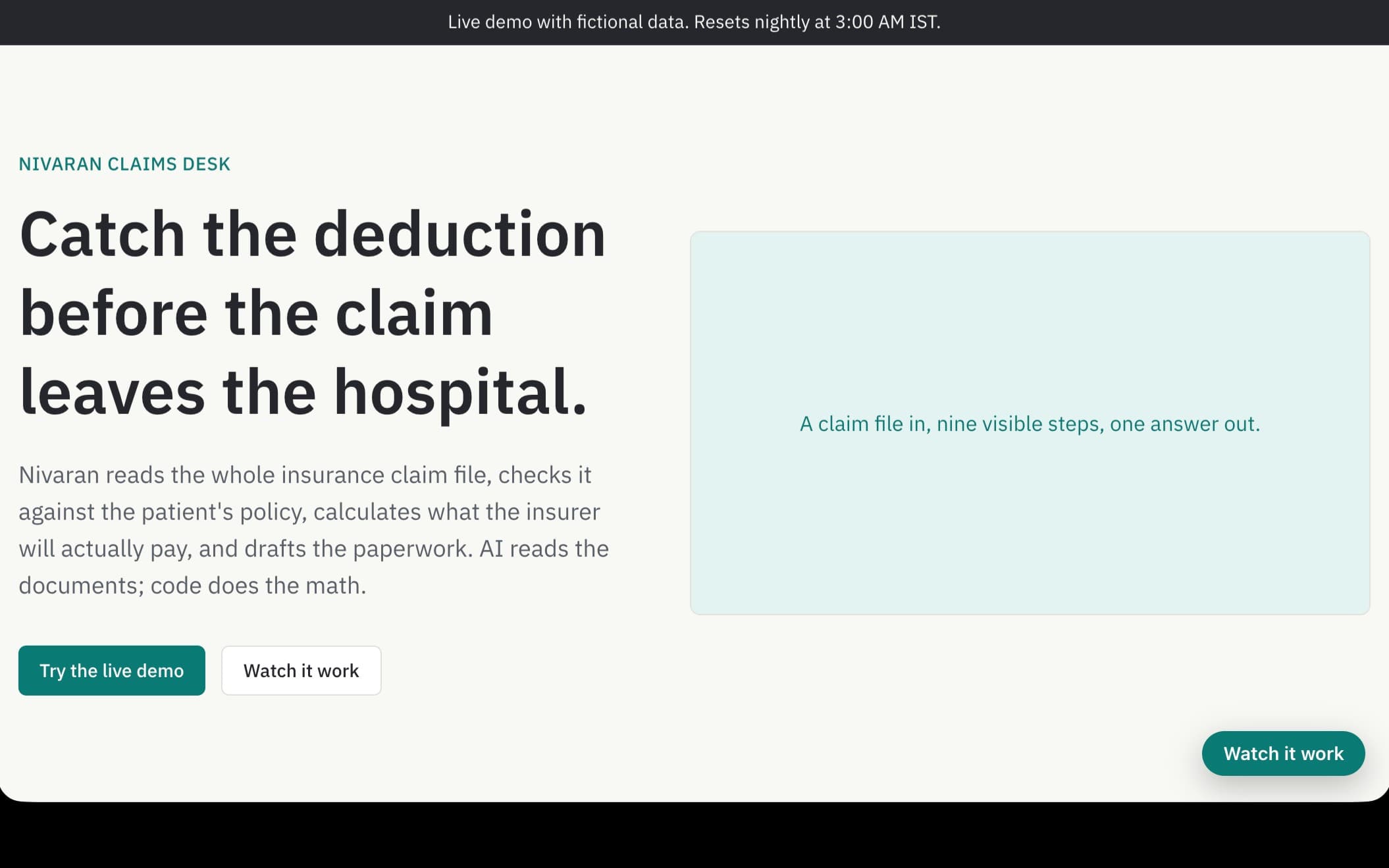
Nivaran reads a hospital's entire insurance claim file, checks it against the patient's policy, calculates what the insurer will actually pay, flags what is missing, and drafts the paperwork, all before the file leaves the hospital.
- TYPE
- Web Application
- INDUSTRY
- Healthcare: hospital insurance (TPA) desks and revenue cycle management
- YEAR
- 2026
- DURATION
- 3 weeks
- PILLAR
- Product Building
What was needed.
Every hospital insurance desk in India fights the same battle. A file goes out with a missing document, a name mismatch or a room above the patient's eligibility. The insurer then raises a query or cuts the payout, and the hospital or the patient absorbs the loss. Nivaran catches these problems before submission. Its core principle is "AI reads, code calculates." The AI reads and sorts the documents, while plain, testable code does all the money calculations, accurate to the paisa. The setting is a fictional three-branch hospital chain, Sahyog Multispeciality Hospitals (Ahmedabad, Vadodara, Surat), working with six fictional insurers and 60 policy products.
What we shipped.
Nine-step processing pipeline: reads the file, labels each page, pulls out the data, checks the policy, calculates the payout, scores readiness and drafts the paperwork. Each step appears live on screen as it runs, and past runs can be replayed. Money engine: applies room-rent caps with proportionate deductions, co-pay, waiting periods, disease sub-limits, non-payable items, riders and duplicate-line detection. Every rupee deducted shows its formula. What-if panel: change the room category, add or remove a rider, or drop a bill line, and the payable amount recalculates instantly. Readiness score and ranked fixes: shows what to fix before submitting, ordered by rupees saved. Claim documents: realistic claim packets generated by code (bills, e-cards, discharge summaries, handwritten case papers), with 40 of them made to look scanned. Screens: claim queue with filters, search and keyboard shortcuts; claim view with a document viewer that highlights where each value came from; CFO insights on revenue leakage and insurer comparison; a rules sandbox; an AI run trace; and an AI usage and cost dashboard. Demo setup: one-click persona login, 11 storyline claims with exact pinned numbers, 18 months of realistic data that seeds in about 9 seconds and resets nightly, and every AI output labelled with how it was made. AI safeguards: a daily budget cap and a per-visitor limit. If the AI fails or the budget runs out, the app falls back to saved or rule-based results, so it never crashes.